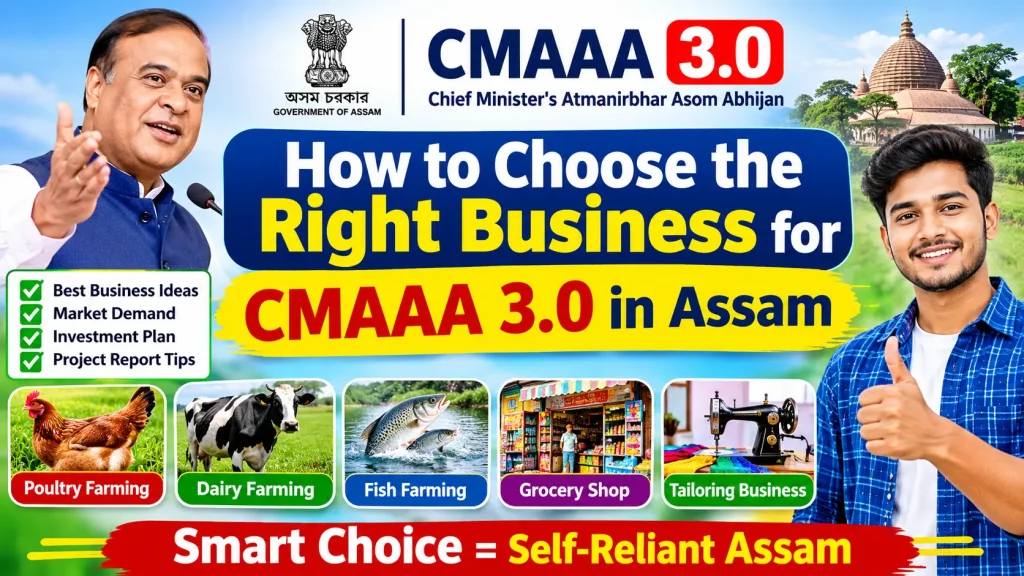
Starting a business is a big decision. Many young people in Assam want to become self-employed instead of depending only on government or private jobs. However, one common problem is choosing the right business.
If you are planning to apply under the Chief Minister’s Atmanirbhar Asom Abhijan (CMAAA) 3.0, selecting a suitable business is one of the first things you should think about.
You may have several ideas, such as starting a poultry farm, opening a grocery shop, running a dairy business or setting up a small manufacturing unit. But which one is right for you?
The answer depends on your skills, available investment, location, customer demand and ability to manage the business.
In this article, you will learn how to choose the right business for CMAAA 3.0 in Assam, what factors to consider before making a decision and how to prepare a practical business plan.
What Is CMAAA 3.0?
CMAAA stands for Chief Minister’s Atmanirbhar Asom Abhijan. It is an initiative of the Government of Assam that aims to encourage entrepreneurship and help eligible young people become self-employed.
The scheme focuses on supporting people who want to establish income-generating activities and develop their own businesses.
Instead of looking for a job, applicants can work towards starting an enterprise based on their interests, qualifications and local business opportunities.
Before selecting a business, applicants should check the latest CMAAA 3.0 notification, eligibility conditions, financial assistance rules and approved business sectors through the official portal.
Official website: https://cmaaa.assam.gov.in/
Why Is Choosing the Right Business Important?
Choosing a business only because someone else is earning money from it can be a mistake.
For example, your friend may be running a successful poultry farm. But that does not mean the same business will be profitable in your village.
Every business has different requirements. Some need more space, while others require technical knowledge, regular maintenance or access to customers.
Here are some reasons why selecting the right business matters:
- Better use of investment: You can spend money on the things your business actually needs.
- Local customer demand: A business based on local demand has a better chance of finding customers.
- Easier management: Choosing work that matches your skills makes daily operations easier.
- Long-term income: A properly planned business can generate income for many years.
- Lower business risk: Understanding the market and expenses before starting can help avoid unnecessary losses.
Your main aim should be to select a business that you can manage properly, not simply one that looks profitable on paper.
Best Business Ideas to Consider for CMAAA 3.0 in Assam
Assam has opportunities in agriculture, animal husbandry, fisheries, food processing, manufacturing, retail and different service-based businesses.
The following are some ideas you can study before preparing your project report. Their eligibility under CMAAA 3.0 must be checked against the final official guidelines.
1. Poultry Farming
Poultry farming is one business idea worth considering in rural and semi-urban areas of Assam.
People regularly purchase chicken and eggs for household consumption, restaurants and local markets.
You can consider starting:
- Broiler poultry farming
- Layer poultry farming
- Small-scale egg production
- Poultry feed and related services
Before starting, study the availability of poultry feed, veterinary services, electricity, water and nearby buyers.
You should also calculate the cost of chicks, housing, feed, medicines and transportation.
2. Dairy Farming
Dairy farming can be a suitable option for people who have enough space and are interested in animal care.
Milk is used by households, tea stalls, sweet shops, hotels and other businesses.
Before choosing dairy farming, consider:
- Availability of good-quality cattle
- Daily feeding expenses
- Veterinary facilities
- Water and cattle shed requirements
- Local demand for fresh milk
- Transportation and storage facilities
Remember that dairy farming requires regular attention. You should be prepared to look after the animals every day.
3. Fish Farming
Fish is an important food item in Assam, making fish farming another business idea to study.
If you have access to a suitable pond or land, you can explore small-scale fish farming.
Some important things to consider include:
- Availability of suitable ponds
- Quality of water
- Fish seed availability
- Fish feed expenses
- Local market prices
- Knowledge of fish farming techniques
Do not start fish farming without understanding the basic requirements. Taking advice from the local Fisheries Department or an experienced fish farmer can help.
4. Grocery Shop
A grocery shop can be a practical business for people living in villages, towns and residential areas.
People regularly purchase rice, pulses, cooking oil, vegetables, household products and other daily necessities.
Before opening a grocery shop, check whether there are already several similar shops in your area.
Think about the following:
- How many households are nearby?
- Which products do people purchase regularly?
- Is the shop location easy to access?
- How much stock will you need?
- What are the monthly rent and electricity expenses?
A small grocery shop with proper stock management and customer service can become a regular source of income.
5. Food Processing Business
Assam has many local food products that can be developed into small businesses.
You can explore food processing activities such as:
- Pickle making
- Spice processing and packaging
- Traditional snacks production
- Rice-based food products
- Mustard oil processing
- Local food packaging
For this type of business, you should understand raw material availability, packaging costs, food safety requirements and potential buyers.
If your business involves packaged food, check the applicable FSSAI registration or licensing requirements.
6. Tailoring and Garment Business
Tailoring and garment-related businesses can be suitable for people who already have sewing skills or an interest in clothing production.
Possible business activities include:
- Tailoring shop
- Boutique
- School uniform stitching
- Traditional Assamese clothing production
- Small garment manufacturing unit
You should consider the cost of sewing machines, fabric, accessories, shop rent and electricity.
It is also useful to identify potential customers before purchasing expensive machinery.
7. Mobile Repairing and Electronic Services
Mobile phones and electronic devices are widely used in Assam. Repairing services can be a good option in areas where people have limited access to reliable technicians.
Possible services include:
- Mobile phone repairing
- Computer repairing
- Laptop servicing
- Electronics maintenance
- Mobile accessories sales
Technical knowledge is important in this business. If you do not have the necessary skills, consider completing proper training before investing.
8. Small Manufacturing Business
If you are interested in producing goods rather than simply selling them, you can explore small manufacturing activities.
Some examples include:
- Paper plate manufacturing
- Candle making
- Agarbatti production
- Bamboo products
- Furniture manufacturing
- Packaging materials
Before selecting a manufacturing business, calculate the machinery cost, raw material expenses, labour requirements and availability of buyers.
Producing goods is only one part of the business. You also need a proper plan for selling them.
How to Choose the Right Business for CMAAA 3.0
Now that you have some business ideas, the next question is how to select the best one.
Follow these steps before making your final decision.
Step 1: Identify Your Skills and Interests
Start by understanding what you can do.
For example, if you have experience in agriculture, you may find an agriculture-related business easier to manage.
If you know how to repair mobile phones, an electronics repair business may be more suitable.
Ask yourself:
- What work do I already know?
- Do I have any technical skills?
- Have I worked in a similar business before?
- Am I interested in managing this business every day?
Your skills and interest should be among the first things you consider.
Step 2: Understand Your Local Market
A business cannot survive without customers.
Before selecting a business, visit nearby markets and talk to local people.
Try to understand what products or services are in demand in your area.
For example, a grocery shop may be suitable in a residential village where people need daily household products.
Similarly, fish farming may be worth considering if you have a suitable pond and access to fish markets.
Do not depend only on assumptions. Try to collect real information from potential customers and local business owners.
Step 3: Calculate Your Total Investment
Every business requires money to start and operate.
You should prepare a list of all expected expenses before finalising your idea.
These may include:
- Machinery and equipment
- Shop or workspace expenses
- Raw materials
- Furniture and tools
- Transportation
- Electricity and water
- Labour costs
- Working capital
Do not calculate only the initial purchase cost. You should also consider the money required to operate the business during its first few months.
Step 4: Check the Availability of Raw Materials
Some businesses depend on regular supplies of raw materials.
For example, poultry farming requires feed, while food processing requires a steady supply of ingredients.
If materials are difficult to obtain in your area, transportation costs may increase your expenses.
Choose a business where you can arrange the required materials without unnecessary difficulty.
Step 5: Study Your Competitors
Visit shops and businesses that are already operating in your area.
Observe their products, prices, customer service and business activities.
Try to identify what you can do differently.
For example, if several grocery shops are already operating nearby, you may need a better location, more convenient products or improved customer service.
Competition does not always mean you should avoid a business. It means you need to understand how you will attract customers.
Step 6: Check the CMAAA 3.0 Business Guidelines
This step is very important.
Not every business idea is automatically eligible under a government scheme.
Before preparing your final project report, check the official CMAAA 3.0 guidelines and available sector-wise project templates.
Make sure that:
- Your proposed activity is permitted.
- Your business category matches the applicable scheme rules.
- Your proposed investment follows the prescribed limits.
- Your project report contains the required information.
- You can arrange any additional documents required for your business.
Do not rely on old application rules without checking the new notification.
Step 7: Prepare a Practical Business Plan
After selecting your business, prepare a clear business plan.
Your plan should explain what you want to start, where you will operate, how much money you need and how you expect to earn.
A realistic plan is better than showing very high profits without proper calculations.
Business Selection Based on Your Location in Assam
Your location can play an important role in deciding which business to start.
Different areas of Assam have different business opportunities.
Here are some examples to help you think about your options.
| Location or Area | Business Ideas to Explore |
|---|---|
| Rural villages | Poultry, dairy, fish farming, agriculture |
| Small towns | Grocery shop, tailoring, mobile repairing |
| Market areas | Retail shop, food processing, garment business |
| Agricultural areas | Food processing, machinery services, farming-related activities |
| Urban areas | Computer services, repairing, manufacturing, retail |
These are only general suggestions. You should study the actual demand, competition and resources available in your locality before selecting a business.
How to Prepare a Business Project Report for CMAAA 3.0
After choosing your business, the next important task is preparing the project report.
A project report explains your proposed business and how you plan to operate it.
For example, if you want to start a poultry farm, your project report should explain the type of poultry farming, required infrastructure, number of birds, feed expenses and expected production.
A good project report generally includes the following sections:
- Business Introduction: Explain the business you want to start.
- Business Objectives: Mention what you want to achieve.
- Location Details: Explain where your business will operate.
- Market Analysis: Describe customer demand and competition.
- Machinery and Equipment: List the tools and machinery required.
- Investment Details: Provide an estimated cost breakdown.
- Working Capital: Explain the money required for daily operations.
- Income and Expenses: Estimate sales, operating expenses and expected profit.
- Marketing Plan: Explain how you will find customers.
- Future Plan: Describe how you want to develop the business.
Your calculations should be based on actual local prices and realistic business expectations.
Common Mistakes to Avoid When Selecting a Business
Many people make mistakes because they rush to choose a business without doing proper research.
Avoid these common problems:
1. Selecting a Business Only for Financial Assistance
Do not select a business simply because you expect to receive financial assistance. You should have a genuine interest in operating it.
2. Copying Someone Else’s Project Report
A project report should match your own business location, investment requirements and market conditions. Copying another person’s report may create problems.
3. Ignoring Customer Demand
A business may look attractive, but without enough customers, it can struggle to survive.
4. Underestimating Expenses
Remember to include maintenance, transportation, electricity, rent and other regular costs.
5. Expecting Immediate Profit
Most businesses need time to develop a customer base and become financially stable.
6. Ignoring Official Guidelines
Always check the latest CMAAA 3.0 rules before selecting a sector or submitting your project report.
Example: How to Compare Two Business Ideas
Suppose you are confused between starting a poultry farm and opening a grocery shop.
You can compare both businesses before making your decision.
| Factors | Poultry Farming | Grocery Shop |
|---|---|---|
| Main requirement | Shed, birds, feed | Shop, stock, shelves |
| Skills | Animal care | Sales and stock management |
| Customer base | Traders and consumers | Local households |
| Daily work | Feeding and monitoring | Customer service and stock management |
| Main risks | Disease and feed costs | Competition and unsold stock |
This comparison does not mean one business is better than the other.
If you have suitable space and knowledge of poultry farming, it may be worth exploring.
If you have a good shop location and understand local customer demand, a grocery shop may be more practical.
The right choice depends on your personal situation.
Final Checklist Before Choosing Your CMAAA 3.0 Business
Before finalising your business idea, go through this checklist:
- I have selected a business that matches my skills.
- I have checked local customer demand.
- I have studied nearby competitors.
- I have calculated the initial investment.
- I have estimated monthly operating expenses.
- I know where to purchase raw materials.
- I understand the basic requirements of the business.
- I have checked the applicable CMAAA 3.0 guidelines.
- I am ready to prepare a realistic project report.
If you can answer these questions properly, you will be in a better position to make your business decision.
Frequently Asked Questions (FAQs)
1. Which business is best for CMAAA 3.0 in Assam?
There is no single best business for everyone. Poultry farming, dairy farming, fish farming, grocery shops, food processing and small manufacturing are some ideas worth exploring. Your final choice should depend on your skills, location, investment and customer demand.
2. Can I start a poultry farm under CMAAA 3.0?
Poultry farming is an activity that has appeared among business options in earlier CMAAA-related materials. However, you should check the final CMAAA 3.0 sector list and guidelines to confirm its eligibility.
3. Is a grocery shop a good business idea for CMAAA 3.0?
A grocery shop can be worth considering if there is sufficient demand in your area. Before starting, study nearby shops, customer requirements, stock expenses and competition. Also verify whether the proposed activity is allowed under the applicable scheme rules.
4. Can I choose a business according to my educational qualification?
You should consider your education, practical skills and experience when selecting a business. However, the applicable educational and professional-category requirements must be checked in the official CMAAA 3.0 notification.
5. Do I need a project report for CMAAA 3.0?
Applicants in earlier CMAAA phases were required to submit project reports for selected sectors or sub-sectors. Check the current application instructions to confirm the project report requirements for your chosen activity.
6. Can I prepare my own CMAAA 3.0 project report?
You can prepare your own project report if you understand the business requirements and can provide accurate details. You may also seek guidance from experienced business owners or relevant government departments.
7. Can I choose a business without previous experience?
Your previous experience can help, but you should understand the business before investing. Consider getting proper training or practical guidance if the activity requires technical knowledge.
8. Where can I check the official CMAAA 3.0 guidelines?
Visit the official Government of Assam CMAAA portal at https://cmaaa.assam.gov.in/ to check scheme notifications, application instructions and other official information.
Conclusion
Choosing the right business is an important step towards becoming self-employed under CMAAA 3.0 in Assam.
Do not select a business just because it is popular or someone else is earning money from it. Take time to understand your skills, local market demand, investment requirements and business expenses.
Whether you are interested in poultry farming, dairy farming, fish farming, retail or manufacturing, prepare a practical plan before moving forward.
Most importantly, check the latest official CMAAA 3.0 guidelines before finalising your business idea and preparing your project report.
A well-planned business can give you an opportunity to build your own income and contribute to Assam’s growing entrepreneurial community.